Safety + Legality
How to Ride a Semi-Automatic Motorbike: Gears, Brakes and Stops
A semi-automatic motorbike changes gear with a foot lever but has no hand-operated clutch. That makes it different from both a manual motorcycle and a fully automatic scooter. On bikes in the Wave, Future and Cub families, you still need to choose a gear and coordinate that change with the throttle.
If you are searching for how to ride a semi-automatic scooter in Vietnam, first identify the exact bike you will use. Similar-looking models can have different shift arrangements, starting procedures and brakes. This AZ Motorbikes guide is preparation for supervised practice, not a substitute for a riding course or the owner’s manual.
Identify the controls before starting
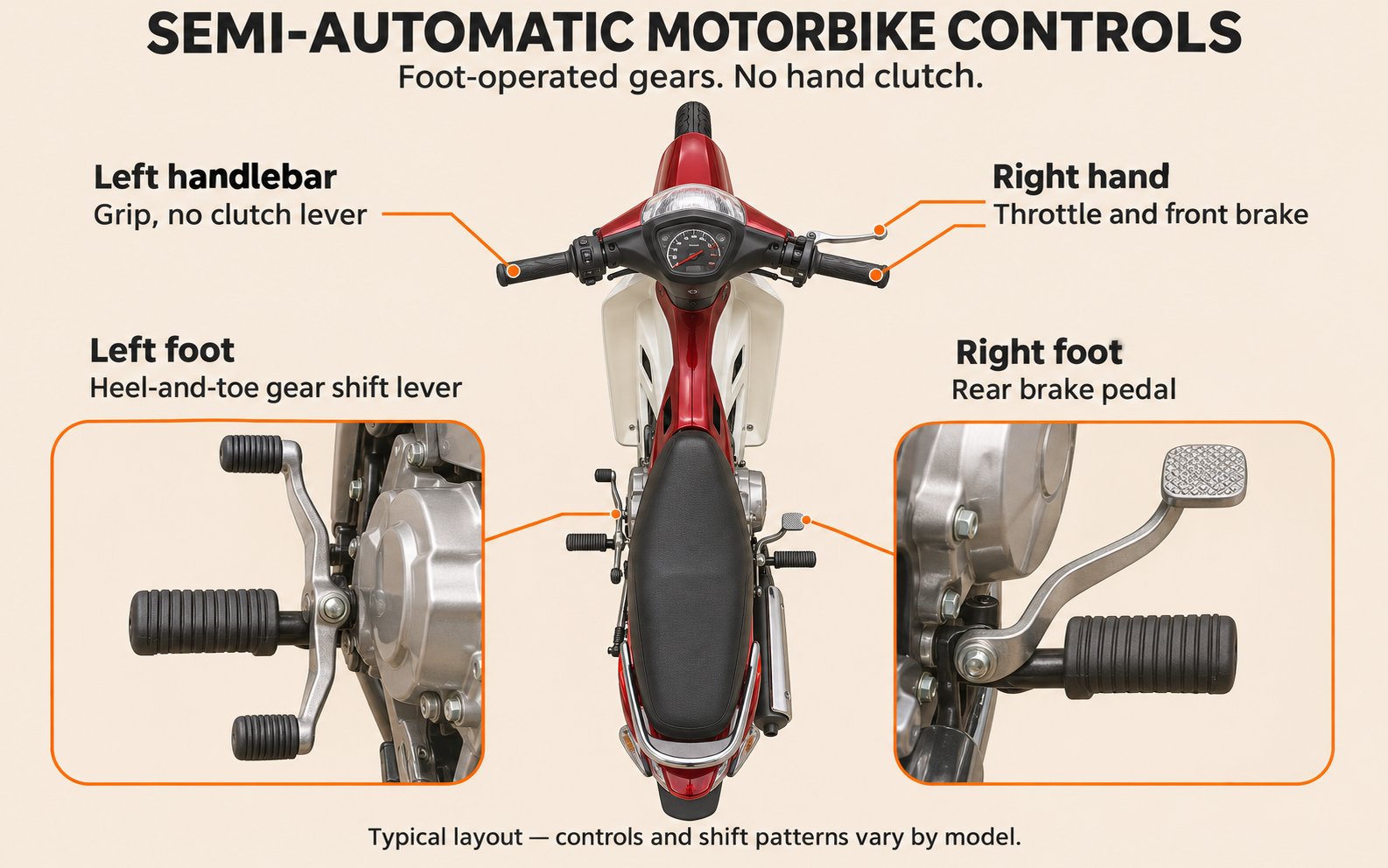
On a typical underbone semi-automatic, the right-hand lever operates the front brake, the right-foot pedal operates the rear brake, and the left-foot lever changes gear. The right grip is the throttle. Someone used to a scooter may instinctively reach for a left-hand rear brake that is not there.
With the engine off, locate each control and check its movement. Have the shift pattern explained on that exact motorcycle. A heel-and-toe lever has two operating surfaces; their direction of use should not be guessed from a different bike.
Confirm neutral using the gear indicator where fitted. Check the tyres, brakes, lights and throttle return before riding. Wear a helmet and protective riding equipment, and practise in a permitted area away from traffic with a qualified instructor.
How the automatic clutch changes the riding process
You do not release a hand clutch to move away. The clutch mechanism manages engagement, while your throttle input controls how the bike begins to pull. This reduces the number of hand controls but does not make abrupt throttle inputs harmless.
It also means that stopping the motorcycle does not necessarily mean it is in neutral. Treat the throttle as live whenever the engine is running and a gear is selected. Keep it closed while you are stationary and hold the bike securely with the brakes.
Starting and moving away
- Follow the model’s starting procedure and confirm neutral. Make sure the stands are fully raised before moving.
- Keep the throttle closed and the bike held with the brakes while selecting first gear using the correct direction of the shift lever.
- Let the lever return fully. Check the way ahead and, as you release the brakes to move, open the throttle gently.
- Bring your feet onto the footrests once moving and balanced. Look ahead rather than down at the gear display.
Keep the first practice exercise simple: moving a short distance in a straight line and making a controlled stop. Do not combine your first gear changes with traffic, a passenger or a steep hill.
Changing gears smoothly
Upshifting
Ease the throttle closed before operating the gear lever. Make one complete, controlled change, let the lever return and then reopen the throttle smoothly. Avoid keeping engine power applied while forcing the shift.
Take your foot off the lever between changes. If selecting a gear repeatedly requires unusual force or produces a severe jolt, stop somewhere safe and have the bike checked instead of stamping harder.
Downshifting
Slow down before choosing a lower gear. Close the throttle, select an appropriate lower gear and reconnect power gently. The lower gear must suit the road speed: an abrupt downshift at excessive speed can over-rev the engine and upset the motorcycle.
Do not use a generic online table as a target for shifting speeds. Consult the manual or gear-speed markings for your actual model. A heavily loaded bike on a climb will not respond like an unloaded one on level ground.
Can fourth gear go straight to neutral?
Some Honda rotary-pattern transmissions allow this only when the bike is stopped. It is not a procedure to attempt while moving, and it must not be assumed for every Cub, Wave or similar-looking bike. Confirm your model’s pattern; never force the lever to find neutral.
Using the front and rear brakes
Close the throttle, squeeze the front brake progressively and apply the rear brake with controlled pressure. Use both brakes rather than depending on the rear pedal alone. Plan normal stops early so you can reduce speed, select suitable gears and finish upright with the handlebars straight.
At a stop, keep the throttle closed and hold the brakes. Check which gear is selected before moving again. Neutral may be useful when stopped, but it is not a substitute for holding the motorcycle securely, especially on a slope.
Learn the braking equipment on the exact bike. A combined braking system is not the same as ABS, and neither means that every wheel has anti-lock protection. Practise emergency stops with an instructor rather than testing the limit of grip on a public road.
Riding downhill and approaching corners
Choose a suitable gear before a descent so engine braking can help control speed. Do not select neutral or hold the shift pedal down to coast. Continuous brake dragging on a long slope can cause overheating; use the manufacturer’s recommended combination of engine braking and controlled brake applications.
Slow and make planned gear changes before a bend wherever possible. If the road is slippery, increase the space you leave and make every input gentler. If you cannot comfortably control your speed on a route, stop safely and reconsider the journey rather than continuing to a steeper section.
Is a semi-automatic right for your Vietnam trip?
Less clutch coordination can be convenient, but your balance, observation and braking skills still matter. Compare the practical differences in our guide to choosing a motorbike in Vietnam. If the bike you are considering has a hand clutch, read the separate manual motorcycle clutch and gear guide.
Before booking, check our Vietnam motorcycle licence guide and, where relevant, the International Driving Permit guide. Transmission type alone does not determine whether you are legally entitled or insured to ride.
Questions beginners ask
Do I need to use a clutch lever?
Not on the conventional semi-automatic underbone described here. You operate the foot shifter and throttle; the clutch works without a hand lever.
Is a semi-automatic easier than a scooter?
A scooter removes manual gear selection, while a semi-automatic asks you to choose gears. Familiarity with one does not remove the need to learn the other’s controls.
Where can I compare suitable bikes?
Browse the AZ semi-automatic rental catalogue and contact AZ with your experience and route. Ask about the controls and condition of the actual bike rather than relying only on a model name.
Further reading
Check the Honda Vietnam owner’s manual library for your model and year. Honda’s 2024 Super Cub C125 manual illustrates why gear selection and brake equipment must be checked by model; its specifications should not be transferred to every rental Cub. The Ontario motorcycle handbook provides further general riding and braking guidance.