
Culture
A Typical Vietnamese Dinner in a Local Homestay
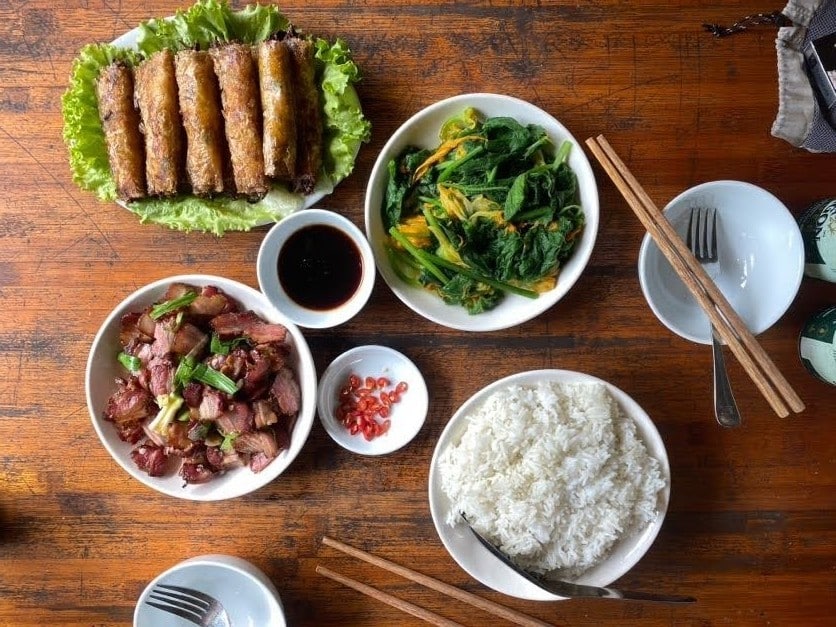
You have not really visited Vietnam unless you stay in a homestay. Nowadays, you can choose the cheaper shared dorm option or take a private room. However, the chances are that you will have no choice but to experience the traditional vietnamese dinner, freshly prepared by your local hosts.
This is DEFINITELY A GOOD OPTION
Dinner in a Local Homestay
When you have a meal with a typical vietnamese family, you can expect to see these main components:
A main dish with meat or seafood.
This could be something like: braised pork belly and eggs [thịt kho tàu], caramelized fish in a clay pot [cá kho tộ], or ginger chicken [gà kho gừng].
A vegetable dish
This is usually a simple boiled or stir fried dish, such as:
boiled greens [rau luộc] with a dipping sauce or stir-fried vegetables [rau xào] like morning glory with garlic).
A clear broth or soup
often light and refreshing broth [canh], with vegetables or a little meat/seafood
E.g., sour soup [canh chua], winter melon soup [canh bí đao] .
Steamed white rice:
[cơm trắng], served in a communal bowl, with individual smaller bowls for each diner.
This combination provides a balanced meal with different textures and flavors.
How is the meal structured?
Meals are typically served “family style.” Large dishes of meat, vegetables, and soup are placed in the center of the table. Each person gets a small individual bowl of plain steamed rice.
You then take portions from the communal dishes to eat with your rice. The soup is often served in a large communal bowl as well, from which you ladle individual portions into your small soup bowl.ach diner will have their own small bowl, which they can fill with items from the centre of the table.
What utensils will I see and be able to use?
At most every meal you will find:
- Chopsticks (đũa): Primarily used to pick up food from the communal dishes and to eat the solid components with your rice.
- Large Spoon (muỗng): Essential for eating the broth/soup and often used to help scoop rice or sauce onto your spoon for easier eating.
- Small individual rice bowl (chén cơm): For your portion of rice.
- Small individual dipping sauce bowl (chén nước chấm): For your personal dipping sauce.
What is for Dessert?
There is less emphasis on Dessert in Vietnam than there is in western countries. There are many many different desserts to choose from and you will often find these in the larger towns and cities.
However, in a homestay setting you are likely to be offered fresh fruit [Hoa Quả], such as:
- watermelon [dưa hấu]
- dragon fruit [thanh long]
- mango [xoài]
- rambutan [chôm chôm]
- longan [nhãn]
Fruits will be seasonal and will taste delicious.
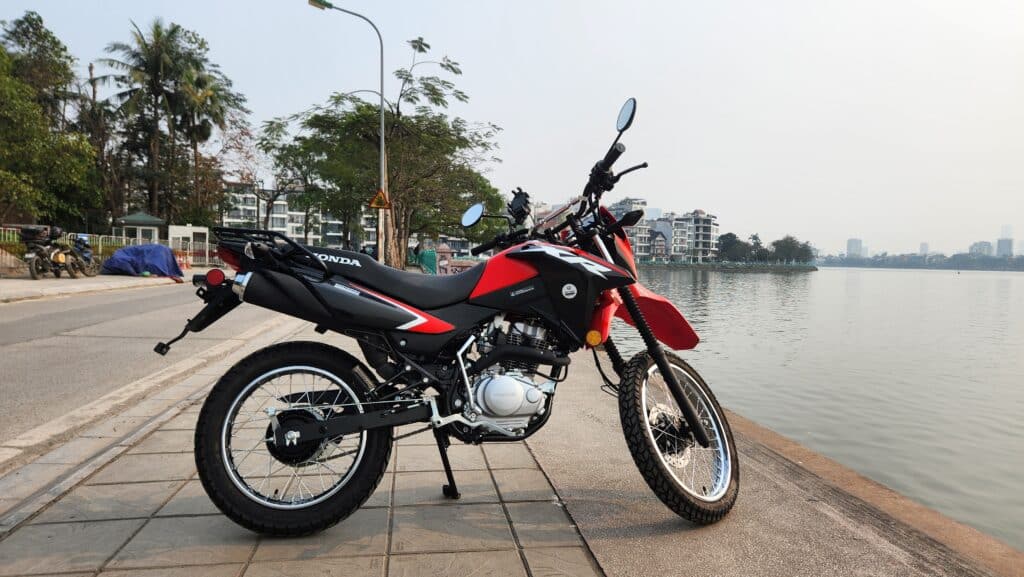
Honda XR 150 Motorcycle Rental
Ready for adventure? The Honda XR150 is your perfect companion for rugged backroads, mountain passes, and open highways.
✅ Lightweight, reliable, and fuel-efficient
✅ Comfortable for long rides and multi-day tours
✅ Trusted by riders across Vietnam for the legendary Ha Giang Loop
FAQ
Is it polite to finish all the rice in my bowl?
Yes! It’s generally polite to finish the rice in your bowl. It shows appreciation and avoids waste.
However, be aware that vietnamese hosts will always want to give you more to show that they respect you. They will always offer more, and more. To combat this, make it clear when you are full/finished eating.
If you do need to ask for more rice, you can ask for a refill (thêm cơm). [pron: tem curm]
What are some tips for tourists trying these meals in local eateries?
- Look for busy spots: A place with many locals usually means good food and reasonable prices.
- Don’t be afraid to point: If needed, look at what others are eating or point to dishes you see.
- Be adventurous: Try different dishes!
- Carry hand sanitizer: Before and after eating, especially at street food stalls.
- Drink bottled water:
- Embrace the experience: It might be a bit chaotic or noisy, but that’s part of the charm!
Is it acceptable to ask for a knife, fork or spoon when eating with a vietnamese family, if I need?
Yes! Absolutely.
Using chopsticks for the first time, or for the infrequent user can be very difficult. In order to save any embarassment and to help with eating, just ask. Vietnamese hosts are more than happy to provide these for you.
Are there any specific table manners I should be aware of?
Generally, we could say:
- Wait for elders/host: It’s polite for the oldest person or host to start eating first.
- Don’t stick chopsticks upright in rice: This resembles incense sticks at a grave and is considered bad luck.
- Don’t make loud slurping noises: While some Asian cultures encourage it, in Vietnam, it’s generally considered less refined, especially for soup.
- Don’t wave chopsticks around: Use them for eating, not for gesturing.
- Don’t reach across others: Ask for a dish to be passed to you.
- Offer to pour drinks: If alcohol or soft drinks are being served, offer to pour for others at the table, especially elders.
What’s the etiquette for serving myself vietnamese food from the communal dishes?
It is a good idea to follow all of the following advice:
- Use the communal serving utensils: Many dishes will have a dedicated serving spoon or chopsticks. Use these, not your personal chopsticks, to take food from the shared plates.
- Take reasonable portions: Don’t overload your bowl. You can always go back for more.
- Don’t pick through the dish: Take what’s in front of you rather than searching for specific pieces, as this can be seen as impolite.
- Pass dishes politely: If someone asks for a dish, pass it to them.
RENT, TOUR, DISCOVER
There are so many more sights, sounds and wonders to experience in Vietnam. Call us bias, but we feel the best way to experience the country is by motorbike, as the locals do.
Whether you would like to RENT or TOUR, get in touch with us to DISCOVER Vietnam.