Safety + Legality
How to Ride a Manual Motorcycle: Clutch, Gears and Braking
Learning how to ride a manual motorcycle starts with coordinating your hands and feet. The clutch controls how engine power reaches the rear wheel, the gear lever selects a ratio, and the brakes control your speed. Getting those actions smooth matters more than moving up to a bigger bike.
This AZ Motorbikes guide explains the controls before a Vietnam rental trip. Use it alongside supervised practical training in a permitted area away from traffic. Reading an article cannot establish that you are ready to ride on public roads. Before choosing a motorcycle, check your entitlement using our Vietnam motorbike licence guide.
Know which control does what
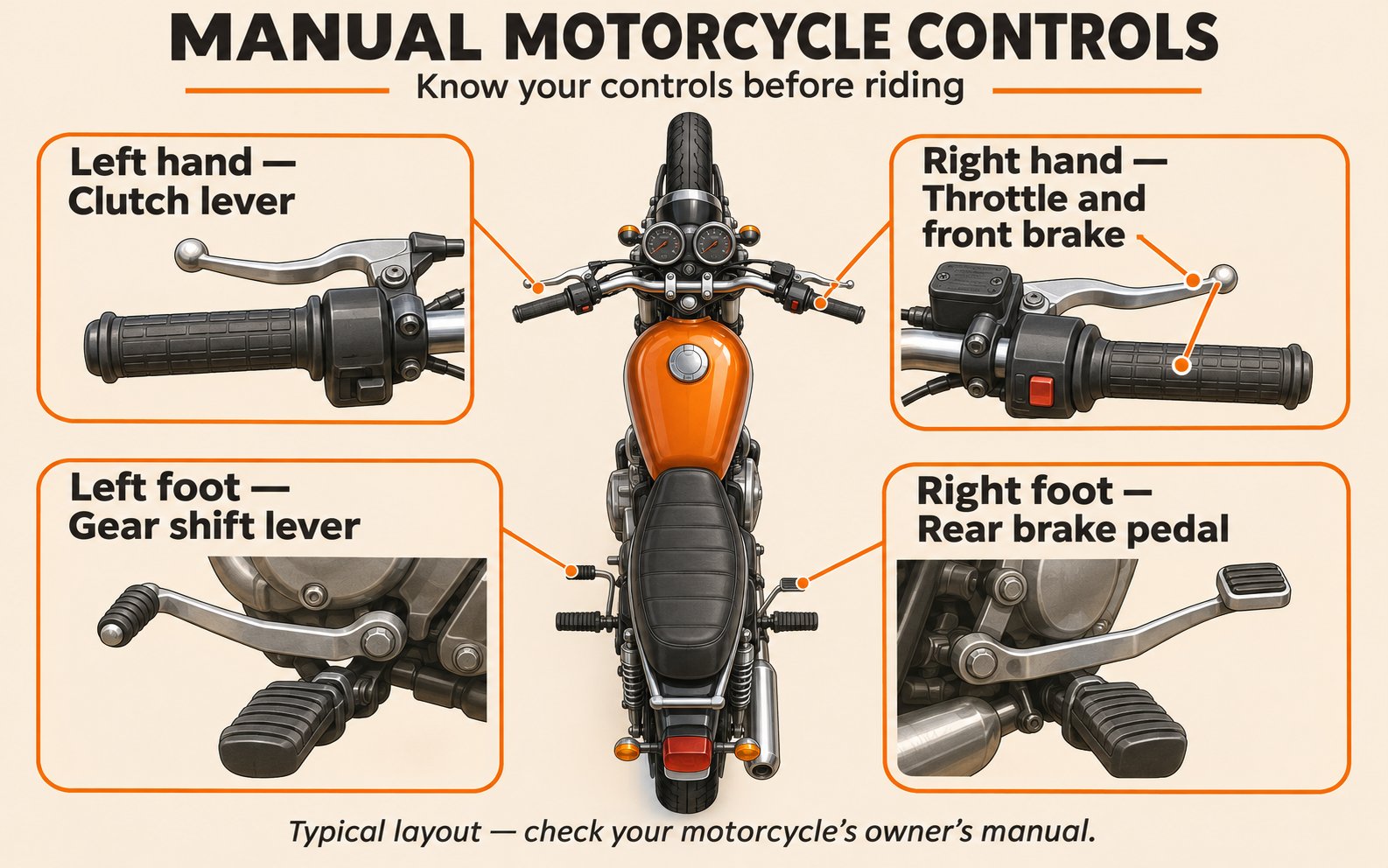
On a conventional manual motorcycle, your left hand operates the clutch and your left foot changes gear. Your right hand operates the throttle and front brake; your right foot operates the rear brake. Confirm that layout on the actual motorcycle before starting it.
A common shift pattern is first gear below neutral, followed by second and the higher gears above neutral. Check the owner’s manual and shift marking rather than assuming every motorcycle is identical. If there is no hand clutch, you may need our semi-automatic motorbike guide instead.
With the engine off and the bike securely supported, locate the engine-stop switch, indicators and horn. Check that you can reach the controls comfortably and support the bike at a stop. Wear a properly fitted helmet, eye protection, gloves, riding footwear and protective clothing.
Clutch control: understand the friction zone
Pulling the clutch lever in separates engine drive from the transmission. As you release it, drive progressively reconnects. The part of the lever’s travel where that connection starts is the friction zone. It is a range of movement, not a button you switch on.
In supervised practice, first learn to recognise the point where the motorcycle wants to move. Use the starting procedure for that model, select first gear with the clutch pulled in, then coordinate a small throttle opening with a gradual clutch release. Once the motorcycle is moving steadily, finish releasing the lever and place your feet on the footrests.
If the motorcycle surges, close the throttle and pull the clutch in while bringing it to a controlled stop. If it stalls, secure the bike with the brakes before restarting. Do not respond by opening the throttle sharply. A recurring stall is a reason to reset the exercise with your instructor, rather than rush into traffic.
How to change gears on a manual motorcycle
Moving into a higher gear
For a normal upshift, ease the throttle closed, pull in the clutch and select the next gear with one deliberate movement. Release the clutch smoothly as you reapply throttle. Let the shift lever return between changes and keep looking ahead.
There is no universal road speed for changing into second or third gear. The engine, gearing, gradient and load all matter. Follow the manufacturer’s guidance and learn the motorcycle’s response with an instructor instead of memorising a generic speed chart.
Changing down without a sudden jolt
Reduce road speed before selecting a lower gear. Use the clutch, select one gear at a time and reconnect drive progressively. Choosing a very low gear while still travelling quickly can produce abrupt engine braking and disturb rear-wheel traction.
Advanced riders may match engine speed with a brief throttle input. That is a skill to learn under supervision, not a reason for a beginner to rush the sequence. Begin with smooth, planned changes while travelling straight; choose a suitable gear before entering a bend.
Braking: learn a smooth stop before a fast ride
For a planned stop, close the throttle and use both brakes progressively. Squeeze the front lever rather than snatching it, and press the rear pedal with control. As speed falls, select appropriate lower gears; pull the clutch in before the engine stalls. Keep the bike upright and the bars straight as you finish the stop, putting a foot down when needed for support.
Do not treat a front/rear braking percentage as an instruction for how hard to squeeze each control. Grip, loading and the motorcycle’s braking system change the response. A rear brake alone is not a substitute for learning to use the front brake correctly.
Practise emergency braking separately with a qualified instructor. Learn whether your specific bike has ABS and on which wheels. ABS does not remove the need for space, good tyres or controlled inputs.
Prepare for slopes and bends
A hill start adds another task: preventing the bike from rolling backwards while drive takes up. Learn that coordination in a controlled lesson before relying on it at a steep junction.
On descents, use an appropriate gear with controlled braking. Do not coast in neutral or hold the clutch in for the whole slope. Complete normal slowing and gear selection before a bend wherever possible, and leave more room when the surface is wet or loose.
Common mistakes to address before a rental trip
- Watching your hands: if you need to look down to locate a control, spend more time familiarising yourself with the stationary bike.
- Releasing the clutch abruptly: work on a smooth connection between throttle and clutch rather than trying to accelerate harder.
- Practising with a passenger: establish solo control first; extra weight changes balance and stopping.
- Choosing by engine size alone: seat height, weight and reach matter too. Our guide to motorbike types in Vietnam explains the differences.
Questions beginners ask
Is riding a manual motorcycle the same as driving a manual car?
The idea of coordinating clutch, engine speed and gear selection is familiar, but the controls and balance demands are different. Car experience does not establish motorcycle competence.
Can I learn on the first day of a Vietnam trip?
Do not make a fixed travel schedule your training deadline. Take practical training before the trip and choose transport that matches the skills you actually have.
Which manual motorcycle should I rent?
Start with your riding experience, licence, route and ability to handle the bike at low speed. Compare the manual motorcycles in the AZ rental catalogue, then tell AZ about your planned ride. Availability and suitability should be discussed before making travel assumptions.
Further reading
For the underlying training principles, see the Ontario motorcycle handbook’s basic riding skills and the Motorcycle Safety Foundation riding guide. Use those sources for riding technique, not as statements of Vietnamese licensing law. The owner’s manual for your particular motorcycle remains the reference for its controls and operation.